Haunted House
About 10 years or so ago, when I came back to the States after having spent several years abroad, I saw the movie "The Nightmare Before Christmas." At the time I thought it totally bizarre, and not in the hey-I-wish-I'd-thought-of-that way...more like the I-hope-whoever-came-up-with-this-is-being-kept-far-away-from-children-and-small-animals way. I've since reconsidered, and I truly appreciate the story of poor Jack Skellington whose fondest wish is to bring joy to children everywhere via some very ghoulish Christmas gifts.
I'm reminded of all this because tomorrow I face a somewhat daunting task: making a Halloween gingerbread house, replete with candy ghosts, jelly bats, and oodles of black icing.
Whoever thought of taking the traditional gingerbread house of Christmas and turning it into an edible bit of Halloween decor? That person must certainly have taken inspiration from Jack Skellington's crew.
Fortunately for me, the gingerbread comes pre-baked, meaning all I have to do is assemble the house and decorate it. Unfortunately for me (and everyone else at the pumpkin-carving party I'll be attending, house in hand), decorating is my weak suit.
Were this a knitted house of wool things might be different. As it is, I have no confidence in my ability to pipe icing windows and line up candy roofing tiles. The kit gives me three "spook-tacular" designs to choose from, and I'm certain I can reproduce none of them. My saving grace is that haunted houses are by design supposed to be crooked, awkward-looking structures; tilting windows and leaning fenceposts can be passed off as deliberate artistic interpretation.
I suppose that if our biggest problem of tomorrow is an imperfect gingerbread house we can call the party a success; will be sure to report on the outcome of mixing beer with carving knives in a later post.
Friday, October 28, 2005


If you thought Chicken Viking Hat was weird....
Just when you thought you'd seen everything, along come penguin sweaters.
Just when you thought you'd seen everything, along come penguin sweaters.
Tuesday, October 25, 2005
Spinning and Felting and Rhinebeck, oh my!
So, I finally made it to the Rhinebeck Sheep and Wool Festival, and boy did I think I'd died and gone to fiber heaven! The fairgrounds were packed with fiber folk; as an added bonus, a gem and mineral fair was also being held, but the beader in me lost out to the knitter and I spent all my time getting lost among the fleece.
My first stop -- an alpaca booth with gorgeous shawls, ponchos and other items all made of soft, soft alpaca -- netted me a bag of treasures and rock-bottom prices: five old Spin-Offs at -- get this -- a quarter apiece; the Lee Raven Handspinning book; the Felted Knits book; and my best bang for the buck: a brand-new umbrella swift for all of five bucks! I passed on the Ashford hand cards and now regret it; at $30 they weren't the absolute steal that the swift was, but they were full-sized cards, brand-new and definitely cheaper than any other place I've seen them. Oh, well.
I also took home a pound of undyed superwash merino; at $15 for the pound I think I did pretty well. My second Rhinebeck regret is not having bought more of it when I had the chance; I went back later in the day and it was sold out. At least I got a business card and can order more by mail if I want.
But the BIG excitement was...(drumroll, please!) I bought a spinning wheel! That's right, I went for it. I pigenholed every spinner I saw and asked what wheels they used, why they liked (or disliked) them, what they would recommend, etc. I then found a wonderful booth where I could test out a variety of wheels...Louet, Majacraft, and Ashford, among others. I finally decided on a Louet S17 with three bobbins, already assembled but unfinished, plus an unfinished Ashford spinning chair. Susan, the owner, was wonderful about helping me decide and letting me test everything for as long as I wanted. I resisted the temptation to add a loom to my purchases at her booth, but I don't know how long I'll be able to keep from adding weaving to my growing list of fiber addictions.
So far I've been very patient about not spinning too much on my Louet before it's finished. DH has put two coats of oil on it so far (after I spun about half a bobbin of beautiful orange Corriedale top...I just couldn't resist giving my wheel a whirl!), and one more coat should be enough to finish it off nicely. My mind is already racing towards what I'll make with my handspun....
And speaking of making stuff with my very own handspun, I took the plunge and made a felted handbag! I had about 50 yards of a super-bulky, olive green and yellow two-ply Corriedale that I wasn't sure what to do with. Paging through Felted Knits yesterday, I saw that the Small Felted Bag would take just about that much yarn, so I pulled out my number 13s and got to work. It took maybe an hour to knit up the entire purse -- a very basic 30-stitch tube sewn together along the cast-on edge. I even braided the remaining yarn and attached it as the purse's handle (MUCH easier than knitting I-cord and it felts to nearly the same look). Today I tossed it into the wash with a few pairs of jeans and three washes later I do believe it's well and truly felted.
Well, I HOPE it's well and truly felted. After wash #2 it was about 2/3 of the way there, so I put it back for one more cycle; let's hope that when it comes out it's a nicely felted shoulder bag and not an unrecognizable blob of wool! If this all works out, I might even add a nice little beaded fringe along the bottom....
Photos of all to follow!
So, I finally made it to the Rhinebeck Sheep and Wool Festival, and boy did I think I'd died and gone to fiber heaven! The fairgrounds were packed with fiber folk; as an added bonus, a gem and mineral fair was also being held, but the beader in me lost out to the knitter and I spent all my time getting lost among the fleece.
My first stop -- an alpaca booth with gorgeous shawls, ponchos and other items all made of soft, soft alpaca -- netted me a bag of treasures and rock-bottom prices: five old Spin-Offs at -- get this -- a quarter apiece; the Lee Raven Handspinning book; the Felted Knits book; and my best bang for the buck: a brand-new umbrella swift for all of five bucks! I passed on the Ashford hand cards and now regret it; at $30 they weren't the absolute steal that the swift was, but they were full-sized cards, brand-new and definitely cheaper than any other place I've seen them. Oh, well.
I also took home a pound of undyed superwash merino; at $15 for the pound I think I did pretty well. My second Rhinebeck regret is not having bought more of it when I had the chance; I went back later in the day and it was sold out. At least I got a business card and can order more by mail if I want.
But the BIG excitement was...(drumroll, please!) I bought a spinning wheel! That's right, I went for it. I pigenholed every spinner I saw and asked what wheels they used, why they liked (or disliked) them, what they would recommend, etc. I then found a wonderful booth where I could test out a variety of wheels...Louet, Majacraft, and Ashford, among others. I finally decided on a Louet S17 with three bobbins, already assembled but unfinished, plus an unfinished Ashford spinning chair. Susan, the owner, was wonderful about helping me decide and letting me test everything for as long as I wanted. I resisted the temptation to add a loom to my purchases at her booth, but I don't know how long I'll be able to keep from adding weaving to my growing list of fiber addictions.
So far I've been very patient about not spinning too much on my Louet before it's finished. DH has put two coats of oil on it so far (after I spun about half a bobbin of beautiful orange Corriedale top...I just couldn't resist giving my wheel a whirl!), and one more coat should be enough to finish it off nicely. My mind is already racing towards what I'll make with my handspun....
And speaking of making stuff with my very own handspun, I took the plunge and made a felted handbag! I had about 50 yards of a super-bulky, olive green and yellow two-ply Corriedale that I wasn't sure what to do with. Paging through Felted Knits yesterday, I saw that the Small Felted Bag would take just about that much yarn, so I pulled out my number 13s and got to work. It took maybe an hour to knit up the entire purse -- a very basic 30-stitch tube sewn together along the cast-on edge. I even braided the remaining yarn and attached it as the purse's handle (MUCH easier than knitting I-cord and it felts to nearly the same look). Today I tossed it into the wash with a few pairs of jeans and three washes later I do believe it's well and truly felted.
Well, I HOPE it's well and truly felted. After wash #2 it was about 2/3 of the way there, so I put it back for one more cycle; let's hope that when it comes out it's a nicely felted shoulder bag and not an unrecognizable blob of wool! If this all works out, I might even add a nice little beaded fringe along the bottom....
Photos of all to follow!
Friday, October 07, 2005
All it takes is one look in my closet to know where I stand.
There they are, all stacked neatly in a cabinet: the brown Riojas, the classic Arizonas, the wine-red Gizehs that took me all around Sweden, the black Ashbys that I wore every day throughout my pregnancy. Yes, I'm a Birkenstocks gal, dyed-in-the-wool. Even Dear Hubby's Wall Street wingtips have been discarded, replaced long ago, not with Birkis -- he, after all, is still in the corporate world -- but with shoes far less Gordon Gekko, far more Jim Anderson in style. Much to DH's feigned chagrin, my commitment to granola does not stop at the breakfast table.
Which is why it wasn't at all surprising to find myself mentally siding with the supporters of copyleft even before I finished reading this week's blog assignment article. The question of copyleft vs. open/open is a no-brainer to me: if something is created with the intention of being made available free of charge, it's inappropriate -- not to mention downright nervy -- to develop a variant of the original and start charging money for it. It puts me in mind of the people who get free stuff from freecycle and then turn around and sell it on ebay. Poor form, to say the least.
Although, I must admit, as I played Devil's Advocate with myself I couldn't help but compare the copyleft vs. open/open debate to the debate that's going on in the pharmaceutical industry these days. The essential question there is should big pharmaceutical companies be allowed to retain copyrights or patents on the medicines they develop. Retaining these rights means the companies can essentially charge whatever they want for their products...even if that means poor people -- even whole nations of them -- suffer and die for lack of money to purchase lifesaving drugs. The drug companies, of course, argue that without the ability to charge outrageous prices for their drugs, there would be no incentive for them to invest in R&D, and less research means fewer cures overall; opponents argue that it's unethical (to say the least) to develop cures that only the world's richest can afford, and that there must be some mechanism for getting the same medicines to the poor without waiting for the drug companies' licenses to expire.
However, there's a key difference between the two debates. Drug research requires funding -- huge amounts of cash to stock the labs and pay the scientists and run the triple-blind studies.... The days of a lone man scraping mold out of a spoiled petri dish and developing a miracle cure are gone. But coding, good coding...that can and is being done every day by everyone from professionals right on down to intrepid high-schoolers hanging out in their parents' basements. The number and virulence of computer worms and viruses -- many of which were developed by students -- seem to indicate that powerful programs can be developed without any corporate revenue supporting them.
The argument that open/open licensing is necessary in order to get vendors to invest in open-source educational software is a moot one. In reality, it doesn't matter much whether or not vendors get involved simply because their greatest resource -- ready access to cash -- is one that the open-source world can get by without. Would a steady influx of cash be nice? Probably. Is it worth sacrificing the "open" nature of open source? Probably not.
"For copyleft advocates, the issue boils down to trust." In a world where the President of the United States is unrepentant about deceiving the public in order to wage a personal war...where corporate malfeasance and the fleecing of the "little guy" have become the business of the day...where public confidence in officials of all stripes is at a record low, is it any wonder that trust is in short supply? The online community sans the vendor industry is talented enough that I for one would be willing to lose the possibility of corporate sponsorship in exchange for guaranteed free access to derivative programs. Let Corporate America invest their money in creating their own paid-licensing programs from scratch instead of building on the backs of free programs and then expecting to turn a profit.
Quintessential capitalist Ronald Reagan is famously quoted as saying "Trust but verify." How deliciously ironic that the arguably anti-capitalist copyleft advocates are following the late president's advice. What better verification can there be for maintaining the accessibility of free programs than copyleft? And when in history have we more surely needed that kind of verification than now?
There they are, all stacked neatly in a cabinet: the brown Riojas, the classic Arizonas, the wine-red Gizehs that took me all around Sweden, the black Ashbys that I wore every day throughout my pregnancy. Yes, I'm a Birkenstocks gal, dyed-in-the-wool. Even Dear Hubby's Wall Street wingtips have been discarded, replaced long ago, not with Birkis -- he, after all, is still in the corporate world -- but with shoes far less Gordon Gekko, far more Jim Anderson in style. Much to DH's feigned chagrin, my commitment to granola does not stop at the breakfast table.
Which is why it wasn't at all surprising to find myself mentally siding with the supporters of copyleft even before I finished reading this week's blog assignment article. The question of copyleft vs. open/open is a no-brainer to me: if something is created with the intention of being made available free of charge, it's inappropriate -- not to mention downright nervy -- to develop a variant of the original and start charging money for it. It puts me in mind of the people who get free stuff from freecycle and then turn around and sell it on ebay. Poor form, to say the least.
Although, I must admit, as I played Devil's Advocate with myself I couldn't help but compare the copyleft vs. open/open debate to the debate that's going on in the pharmaceutical industry these days. The essential question there is should big pharmaceutical companies be allowed to retain copyrights or patents on the medicines they develop. Retaining these rights means the companies can essentially charge whatever they want for their products...even if that means poor people -- even whole nations of them -- suffer and die for lack of money to purchase lifesaving drugs. The drug companies, of course, argue that without the ability to charge outrageous prices for their drugs, there would be no incentive for them to invest in R&D, and less research means fewer cures overall; opponents argue that it's unethical (to say the least) to develop cures that only the world's richest can afford, and that there must be some mechanism for getting the same medicines to the poor without waiting for the drug companies' licenses to expire.
However, there's a key difference between the two debates. Drug research requires funding -- huge amounts of cash to stock the labs and pay the scientists and run the triple-blind studies.... The days of a lone man scraping mold out of a spoiled petri dish and developing a miracle cure are gone. But coding, good coding...that can and is being done every day by everyone from professionals right on down to intrepid high-schoolers hanging out in their parents' basements. The number and virulence of computer worms and viruses -- many of which were developed by students -- seem to indicate that powerful programs can be developed without any corporate revenue supporting them.
The argument that open/open licensing is necessary in order to get vendors to invest in open-source educational software is a moot one. In reality, it doesn't matter much whether or not vendors get involved simply because their greatest resource -- ready access to cash -- is one that the open-source world can get by without. Would a steady influx of cash be nice? Probably. Is it worth sacrificing the "open" nature of open source? Probably not.
"For copyleft advocates, the issue boils down to trust." In a world where the President of the United States is unrepentant about deceiving the public in order to wage a personal war...where corporate malfeasance and the fleecing of the "little guy" have become the business of the day...where public confidence in officials of all stripes is at a record low, is it any wonder that trust is in short supply? The online community sans the vendor industry is talented enough that I for one would be willing to lose the possibility of corporate sponsorship in exchange for guaranteed free access to derivative programs. Let Corporate America invest their money in creating their own paid-licensing programs from scratch instead of building on the backs of free programs and then expecting to turn a profit.
Quintessential capitalist Ronald Reagan is famously quoted as saying "Trust but verify." How deliciously ironic that the arguably anti-capitalist copyleft advocates are following the late president's advice. What better verification can there be for maintaining the accessibility of free programs than copyleft? And when in history have we more surely needed that kind of verification than now?
Thursday, October 06, 2005
I started writing a simple comment to a great blog entry:
Between the Pipes
I then realized that my comment was so long (long-winded??) that I should probably just post it on my own blog. Without further ado, here goes:
I completely agree that the instructor has always been the stitching that holds the small pieces of every course together, both in terms of content and delivery. As you noted in your post, in the f2f classroom, the instructor joins multiple media herself by switching from handouts to overhead slides to the textbook. This "multimedia" has been around for so long that we hardly consider it media at all any more; as such, it has -- perhaps for the best -- become transparent, leaving the instructor and the students to focus on the important part of the lesson, namely the content.
Between the Pipes
I then realized that my comment was so long (long-winded??) that I should probably just post it on my own blog. Without further ado, here goes:
I completely agree that the instructor has always been the stitching that holds the small pieces of every course together, both in terms of content and delivery. As you noted in your post, in the f2f classroom, the instructor joins multiple media herself by switching from handouts to overhead slides to the textbook. This "multimedia" has been around for so long that we hardly consider it media at all any more; as such, it has -- perhaps for the best -- become transparent, leaving the instructor and the students to focus on the important part of the lesson, namely the content.
Online education, being such a relatively new field dealing with such relatively new media, has brought the media of instruction back to its opaque state. With online multimedia staring us so squarely in the face, it's easy for both instructors and students to get lost in the "how" at the expense of the "why." Of course, the "why" must always win out (although in reality it often doesn't). However, I don't think it's possible to leave the "how" completely up to the individual students in the online environment any more than an instructor would leave the "how" up to the students in the f2f classroom.
I think online media may offer a wider array of options than are available in the f2f classroom. After all, a f2f classroom could get pretty chaotic if an instructor told the class to read an assignment either from the textbook, from a photocopy she was passing around or from a slide she was showing. Out of necessity, the f2f instructor needs to choose one medium for that reading and ask everyone to use it, even though some students might prefer one form over the other if given the choice. No such confusion need occur in the online classroom. One group of students could choose to complete a project by communicating through wikis; another group could choose to use a blog; still another could choose to use a forum. However, the instructor still needs to give direction, especially when dealing with students who are less familiar with what technology is out there. The online instructor who tells a group to "complete this project" without providing any suggestions for which media to use may find that the group, when faced with boundless -- perhaps overwhelming -- options, chooses nothing at all. I think this will certainly become less and less of an issue as online media become more and more transparent; this will happen naturally over time as generations of children raised with this technology come of age. Just as the written word was once a revolutionary form of media that completely transformed the nature of knowledge transfer but has now become such a standard that we don't even give its use a second thought, today's "revolutionary" online multimedia will one day be second nature to everyone. In the meantime, though, too many options and too little direction may cause more problems than not (see here for an interesting example).
Wednesday, October 05, 2005
The ring of truth to it....
So, I was reading through a recommended article on what can happen in an online course when too many variables and too much flexibility is introduced, and I was particularly struck by this short paragraph:
We need to find ways of rationalising the assessments, and minimising duplication. At present, it’s very bitsy, with lots of modules, and lots of assessment tasks. I think what we’ll end up with are a few carefully designed projects that cover all areas.
http://makeashorterlink.com/?I12D35CEB
A few carefully designed projects that cover all areas....
Right now, I'm taking an online course...well, two to be exact, the one that requires this blog and another one. It's the other one that's really got my knickers in a twist, so to speak. And I think the problem is that it's very bitsy - full of minute assessment tasks that don't hang together as a whole. I feel like I'm doing busywork instead of developing some integrated understanding of the subject matter and how it applies to my real-world situation. How I wish we had a few carefully designed projects in that course!
But try telling the professor that....
So, I was reading through a recommended article on what can happen in an online course when too many variables and too much flexibility is introduced, and I was particularly struck by this short paragraph:
We need to find ways of rationalising the assessments, and minimising duplication. At present, it’s very bitsy, with lots of modules, and lots of assessment tasks. I think what we’ll end up with are a few carefully designed projects that cover all areas.
http://makeashorterlink.com/?I12D35CEB
A few carefully designed projects that cover all areas....
Right now, I'm taking an online course...well, two to be exact, the one that requires this blog and another one. It's the other one that's really got my knickers in a twist, so to speak. And I think the problem is that it's very bitsy - full of minute assessment tasks that don't hang together as a whole. I feel like I'm doing busywork instead of developing some integrated understanding of the subject matter and how it applies to my real-world situation. How I wish we had a few carefully designed projects in that course!
But try telling the professor that....
Friday, September 30, 2005
More thoughts on Small Pieces, Loosely Joined
So, I spoke a lot about my personal and professional need to have a "joiner" for all the small pieces used in an online course. Now I've gotten to thinking about the pieces themselves. As a designer and instructor, what small pieces would I need to incorporate in any of my classes?
First, then, I need to answer the question of which class.
Interestingly, my boss was just called into a meeting about a potential client - a group of Chinese students who want online ESL classes. None of us knows any more than that, but I'm going to make a couple of assumptions. The students are definitely adults (that's all we teach), so they probably want ESL either for international business purposes or for overseas academic prep (say, attending grad school in the U.S.) purposes. Let's assume, then, that the desire is for academic prep: "We want our students to be able to arrive at their grad schools and be ready to take classes in their major subjects without having to "waste time" with ESL." (This "ESL as a waste of time" philosophy is quite common in our international students...until they realize that all the TOEFL prep they took back in their countries didn't at all prepare them for the reality of sitting in an American classroom with American students and American professors and functioning completely in English). Let's also assume that we would do what we normally do in the face-to-face setting and divide the skills into a reading/writing course and a listening/speaking course.
I'm mainly a reading/writing instructor. For a reading/writing course, the small pieces I would want are:
- a blog interface for students to keep an informal journal (Purpose: get them to write in English, with volume as the goal. Some of these students don't write anything in English except the assignments their teachers give them, and there's something to be said for "use it or lose it." The blog would be a space for them to write without worrying about being graded - kind of a space for writing without fear or intimidation, just to get comfortable with the habit of putting thoughts down on paper in English.)
- email (Purpose: communication. This could include teacher-student, student-teacher, student-student, admin-teacher-student, etc. This would allow private communication - as opposed to notices posted on forums or public message boards - as well as last-minute notifications...anything that needed to be sent and viewed asap. Students would be required to check their email accounts daily for messages. This would also allow students to submit their assignments to me in the absence of a Bb-style "digital drop box.")
- a space to host PowerPoint "lecture" materials (Purpose: give them writing/discourse guidelines, outlines, rubrics...all the stuff we would normally go over in class during f2f "lecture" sessions. I currently use these PowerPoint lectures as an adjunct to my f2f ESL writing classes, and I've gotten a very positive response from my students. Many of them feel it gives them something to hold onto - guidelines they can print out and refer back to when they're unsure of how to organize their writing or find the "real" meaning of what an English-speaking writer is saying in an essay.)
- a space to host links to readings and to post assignments, due dates, syllabus, etc. (Purpose: basic information exchange, basically one-way from teacher to student. I suppose all this could be transferred via email as well, so a separate interface wouldn't be necessary.)
- a threaded discussion space (Purpose: give them a space within which to collaborate on reading analysis/writing process assignments.)
- some sort of online, auto-grading quiz program (Purpose: grammar & editing review. Many of my students can take fill-in-the-blanks tests wonderfully, but ask them to apply the grammar rules they've memorized in order to correct simple sentence errors and they freeze. I want the students to polish their editing skills without getting caught in the "grammar bog" that some ESL writing classes can become. Auto-grading editing quizzes would provide a realistic scenario - here's some text with grammar errors, now edit it - for students to apply their theoretical knowledge to. Results would come back with feedback (and explanations for why a certain correction was necessary if a student got it wrong) and suggestions for independent study (see this book, this chapter) if a student found their skills lacking. Again, I do something similar through Bb with my f2f writing classes. Even though I see the quiz results and assign nominal grades, they're mostly for the students to see where their personal weaknesses are so they can study up.)
- and MAYBE some sort of real-time communication, either as text chat, VOIP or video conferencing (HERE's where I'm kind of unsure. Real-time communication with ESL students can be painful face-to-face. There are issues of comfort level, pronunciation, listening comp and much more. I can see VOIP being an absolute disaster if the students can't understand each other or me - and vice versa - without visual cues. However, video conferencing takes lots of bandwidth and might not be a realistic alternative at this stage. And I can see text chat collapsing under the weight of time and effort it would take for Chinese speakers to type out everything they wanted to say in real time in English. I would want a real-time communication option because the concepts I try to get across in a reading/writing class are really challenging ones. I'm not asking my students to memorize a list of vocabulary words or translate sentences...I'm asking them to re-order the way they think about the world. It's something most of them have never even considered in their own language, much less in a foreign one. So, I think being able to talk these concepts over and analyze how they appear in different texts is crucial, and I think real-time communication is vital for some students to really "get it." I just don't know how well it would work out with a learner group like this.)
So, there we have it...my list of small pieces. Of course, I feel like all these choices are based on the system I know and currently use, which is an LMS. I'd love to hear anyone who has a "well, have you considered this...?" option to give me. What's out there that I haven't even considered using but might add a valuable dimension to what I'm trying to accomplish? Comments, please!
So, I spoke a lot about my personal and professional need to have a "joiner" for all the small pieces used in an online course. Now I've gotten to thinking about the pieces themselves. As a designer and instructor, what small pieces would I need to incorporate in any of my classes?
First, then, I need to answer the question of which class.
Interestingly, my boss was just called into a meeting about a potential client - a group of Chinese students who want online ESL classes. None of us knows any more than that, but I'm going to make a couple of assumptions. The students are definitely adults (that's all we teach), so they probably want ESL either for international business purposes or for overseas academic prep (say, attending grad school in the U.S.) purposes. Let's assume, then, that the desire is for academic prep: "We want our students to be able to arrive at their grad schools and be ready to take classes in their major subjects without having to "waste time" with ESL." (This "ESL as a waste of time" philosophy is quite common in our international students...until they realize that all the TOEFL prep they took back in their countries didn't at all prepare them for the reality of sitting in an American classroom with American students and American professors and functioning completely in English). Let's also assume that we would do what we normally do in the face-to-face setting and divide the skills into a reading/writing course and a listening/speaking course.
I'm mainly a reading/writing instructor. For a reading/writing course, the small pieces I would want are:
- a blog interface for students to keep an informal journal (Purpose: get them to write in English, with volume as the goal. Some of these students don't write anything in English except the assignments their teachers give them, and there's something to be said for "use it or lose it." The blog would be a space for them to write without worrying about being graded - kind of a space for writing without fear or intimidation, just to get comfortable with the habit of putting thoughts down on paper in English.)
- email (Purpose: communication. This could include teacher-student, student-teacher, student-student, admin-teacher-student, etc. This would allow private communication - as opposed to notices posted on forums or public message boards - as well as last-minute notifications...anything that needed to be sent and viewed asap. Students would be required to check their email accounts daily for messages. This would also allow students to submit their assignments to me in the absence of a Bb-style "digital drop box.")
- a space to host PowerPoint "lecture" materials (Purpose: give them writing/discourse guidelines, outlines, rubrics...all the stuff we would normally go over in class during f2f "lecture" sessions. I currently use these PowerPoint lectures as an adjunct to my f2f ESL writing classes, and I've gotten a very positive response from my students. Many of them feel it gives them something to hold onto - guidelines they can print out and refer back to when they're unsure of how to organize their writing or find the "real" meaning of what an English-speaking writer is saying in an essay.)
- a space to host links to readings and to post assignments, due dates, syllabus, etc. (Purpose: basic information exchange, basically one-way from teacher to student. I suppose all this could be transferred via email as well, so a separate interface wouldn't be necessary.)
- a threaded discussion space (Purpose: give them a space within which to collaborate on reading analysis/writing process assignments.)
- some sort of online, auto-grading quiz program (Purpose: grammar & editing review. Many of my students can take fill-in-the-blanks tests wonderfully, but ask them to apply the grammar rules they've memorized in order to correct simple sentence errors and they freeze. I want the students to polish their editing skills without getting caught in the "grammar bog" that some ESL writing classes can become. Auto-grading editing quizzes would provide a realistic scenario - here's some text with grammar errors, now edit it - for students to apply their theoretical knowledge to. Results would come back with feedback (and explanations for why a certain correction was necessary if a student got it wrong) and suggestions for independent study (see this book, this chapter) if a student found their skills lacking. Again, I do something similar through Bb with my f2f writing classes. Even though I see the quiz results and assign nominal grades, they're mostly for the students to see where their personal weaknesses are so they can study up.)
- and MAYBE some sort of real-time communication, either as text chat, VOIP or video conferencing (HERE's where I'm kind of unsure. Real-time communication with ESL students can be painful face-to-face. There are issues of comfort level, pronunciation, listening comp and much more. I can see VOIP being an absolute disaster if the students can't understand each other or me - and vice versa - without visual cues. However, video conferencing takes lots of bandwidth and might not be a realistic alternative at this stage. And I can see text chat collapsing under the weight of time and effort it would take for Chinese speakers to type out everything they wanted to say in real time in English. I would want a real-time communication option because the concepts I try to get across in a reading/writing class are really challenging ones. I'm not asking my students to memorize a list of vocabulary words or translate sentences...I'm asking them to re-order the way they think about the world. It's something most of them have never even considered in their own language, much less in a foreign one. So, I think being able to talk these concepts over and analyze how they appear in different texts is crucial, and I think real-time communication is vital for some students to really "get it." I just don't know how well it would work out with a learner group like this.)
So, there we have it...my list of small pieces. Of course, I feel like all these choices are based on the system I know and currently use, which is an LMS. I'd love to hear anyone who has a "well, have you considered this...?" option to give me. What's out there that I haven't even considered using but might add a valuable dimension to what I'm trying to accomplish? Comments, please!
Thursday, September 29, 2005
Time Lag
Strange...I decided to check my Bloglines feeds after making the previous post to see if my Splindarella feed showed as updated. It didn't. I waited. No change.
I seem to recall reading that Bloglines checks for updates every 30 seconds. Could I be mistaken? Or could there be some other reason why my blog has been updated but my RSS aggregator doesn't seem to realize it?
Strange...I decided to check my Bloglines feeds after making the previous post to see if my Splindarella feed showed as updated. It didn't. I waited. No change.
I seem to recall reading that Bloglines checks for updates every 30 seconds. Could I be mistaken? Or could there be some other reason why my blog has been updated but my RSS aggregator doesn't seem to realize it?
Blogging Assignment 2: Metacognitive Exercise
I feel as though I’ve stepped through Alice’s looking glass this semester. Up till now, my MS classes in the VC have – comfortingly, if not always conveniently – been conducted within the restrictive confines of our own little LMS. I now find myself branching out – blogging here, forum-ing there, trying desperately to keep track of all the “small pieces” that my once-monolithic learning system suddenly seems to have fragmented into.
If, as Clark Aldrich claims, the “loose join” to all those small pieces is Humanity 3.0, I think I must be stuck somewhere back in evolution’s v1.
Don’t get me wrong. I appreciate Mr. Aldrich’s attempt to humanize the fragmented, faceless world of small pieces loosely joined. I appreciate the commentators who echo the sentiment that it’s the people, not the technology, doing the joining. I just don’t buy it, at least not for me.
Maybe I’m a poor organizer at heart. Maybe I need better time-management skills. Maybe my diet is deficient in ginkgo biloba, or maybe I just need to tie more strings around my fingers. Maybe I need a trail of breadcrumbs to follow. All I know is that the one comment that made me heave a sigh of relief came from Harold Jarche, who noted that some small pieces (such as Moodle) are moving towards integration with other small pieces. These “integrated” small-piece systems would preserve the pick-and-choose nature of the loose join while (as I envision it) providing the common connection that we v1 Humans need.
Perhaps v3 Humans can be their own loose joins. Perhaps they can manage their time, their desktops, their resumes well enough to juggle all the connections effortlessly. My admiration for those skillful souls is boundless. I, however, need some help. I need a central source to go to in order to make my loose joins retain some sort of connection; without it, I feel constantly adrift, my small pieces floating ever farther apart in the internet universe.
As an online instructor, I would never be so bold as to assume my students could independently maintain the loose joins of many small pieces since I don’t feel confident doing it myself. I would want some centralized “organizer” to be available (even if students chose not to use it in favor of developing their own organizational and tracking systems) to bring together the disparate pick-and-choose elements. Maybe it would resemble a beefed-up RSS aggregator – capable of linking all the small pieces together, showing when a piece had been updated or changed, summarizing key content from each piece and providing a checklist of what-to-do-when in each piece. Even a simpler aggregator, capable of being a central “holding station” for all the small pieces even if it couldn’t draw content from them to form summaries and checklists, would be preferable to leaving students to fend completely for themselves.
Small pieces loosely joined may be the future – or, at least, one future – of online education. Making sure users have the ability (either self-generated or derived from external sources) to organize, access and keep track of those small pieces is the key to success in that future. Seeing to that might ensure that there will be room in the loosely-joined online learning environment for all versions of Humanity.
I feel as though I’ve stepped through Alice’s looking glass this semester. Up till now, my MS classes in the VC have – comfortingly, if not always conveniently – been conducted within the restrictive confines of our own little LMS. I now find myself branching out – blogging here, forum-ing there, trying desperately to keep track of all the “small pieces” that my once-monolithic learning system suddenly seems to have fragmented into.
If, as Clark Aldrich claims, the “loose join” to all those small pieces is Humanity 3.0, I think I must be stuck somewhere back in evolution’s v1.
Don’t get me wrong. I appreciate Mr. Aldrich’s attempt to humanize the fragmented, faceless world of small pieces loosely joined. I appreciate the commentators who echo the sentiment that it’s the people, not the technology, doing the joining. I just don’t buy it, at least not for me.
Maybe I’m a poor organizer at heart. Maybe I need better time-management skills. Maybe my diet is deficient in ginkgo biloba, or maybe I just need to tie more strings around my fingers. Maybe I need a trail of breadcrumbs to follow. All I know is that the one comment that made me heave a sigh of relief came from Harold Jarche, who noted that some small pieces (such as Moodle) are moving towards integration with other small pieces. These “integrated” small-piece systems would preserve the pick-and-choose nature of the loose join while (as I envision it) providing the common connection that we v1 Humans need.
Perhaps v3 Humans can be their own loose joins. Perhaps they can manage their time, their desktops, their resumes well enough to juggle all the connections effortlessly. My admiration for those skillful souls is boundless. I, however, need some help. I need a central source to go to in order to make my loose joins retain some sort of connection; without it, I feel constantly adrift, my small pieces floating ever farther apart in the internet universe.
As an online instructor, I would never be so bold as to assume my students could independently maintain the loose joins of many small pieces since I don’t feel confident doing it myself. I would want some centralized “organizer” to be available (even if students chose not to use it in favor of developing their own organizational and tracking systems) to bring together the disparate pick-and-choose elements. Maybe it would resemble a beefed-up RSS aggregator – capable of linking all the small pieces together, showing when a piece had been updated or changed, summarizing key content from each piece and providing a checklist of what-to-do-when in each piece. Even a simpler aggregator, capable of being a central “holding station” for all the small pieces even if it couldn’t draw content from them to form summaries and checklists, would be preferable to leaving students to fend completely for themselves.
Small pieces loosely joined may be the future – or, at least, one future – of online education. Making sure users have the ability (either self-generated or derived from external sources) to organize, access and keep track of those small pieces is the key to success in that future. Seeing to that might ensure that there will be room in the loosely-joined online learning environment for all versions of Humanity.
Saturday, September 24, 2005
Friday, September 23, 2005
How could I not link to a blog titled Yarn Harlot? The fact that it's wry and witty and full of photos of to-die-for hand knits is simply icing on the cake. Check it out:
Yarn Harlot
Yarn Harlot
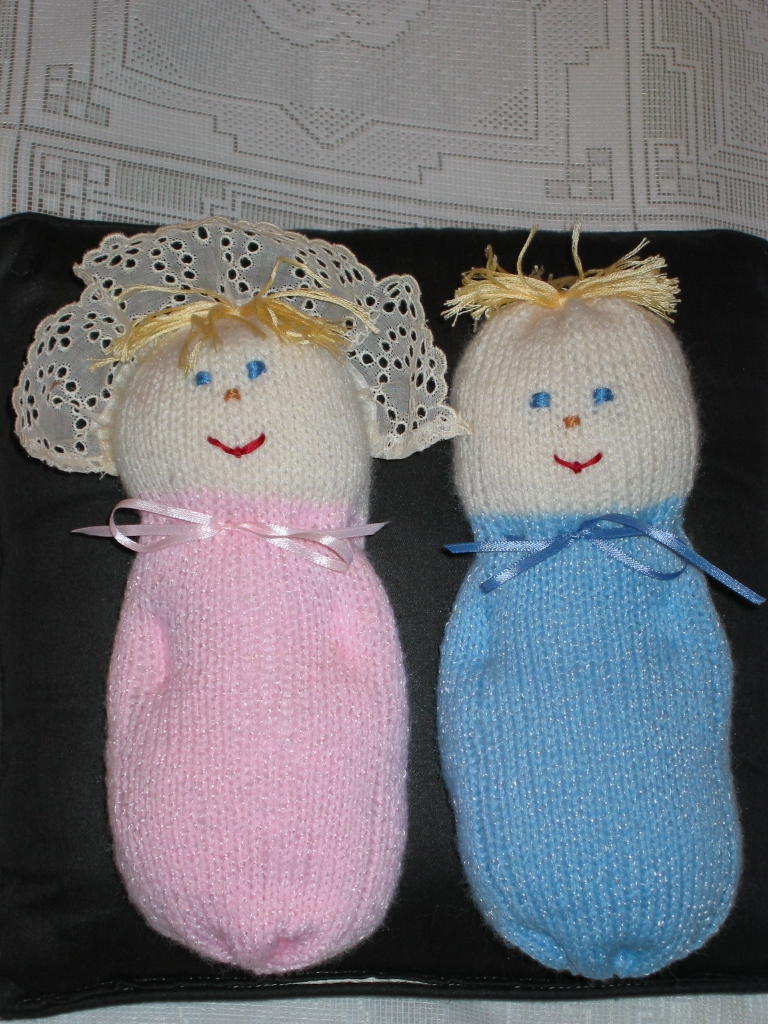
Heather & Max's Dolls
I can't tell you how delighted I am with how these turned out. When my daughter was just shy of 2 months old, she received a doll like the one on the left as a gift. It had black hair and brown eyes, just like my little girl, and it was the perfect size and shape for her small arms to hug. I immediately decided that I needed to make a pair of the dolls to send one of my best friends, who had just given birth to twins.
The doll was easy enough to copy. Not much more than a simple knitted tube, I was surprised that when I added details - face, hair, bow - it came together in such an adorable way. I sent off Heather and Max's dolls when they were about 6 weeks old (they live with their parents in Sweden) and the babies have snuggled up with them ever since.
Wednesday, September 21, 2005

Splindarella's Scarf
Not too shabby, eh? Although I've recently become obsessed with knitting, my first love is crocheting. As soon as I saw the pattern for this crocheted cable scarf, I knew I had to make it. Crocheted lengthwise, it uses super-bulky yarn (machine wash/dry - woo-hoo!) and simple stitches to achieve what is, IMHO, a very impressive effect. Warm as heck, too, and believe it or not, a quick project. Watch out, family - you might all be getting one like this for Christmas!
Tuesday, September 20, 2005
Here goes...our first journal assignment and my first attempt at using Blog This (check out the link at the bottom of this entry for an interesting poem about dead blogs).
Hypermedia
Blog Journal Activity #1
9/20/05
“Blogging + Video=Vlogging” reports on the latest twist on the “traditional” blog (if such a new medium can be called traditional): using video clips instead of written text to keep a blog. The author notes that the number of vlogs has increased dramatically during the past year alone, and she quotes several dedicated vloggers who seem to feel that vlogging has unlimited potential for equalizing the creation and distribution of media. “The potential for everyone to self-publish has the ability to revolutionize the world,” enthuses vlogger Clint Sharp.
Vlogging, no doubt, brings a 21st century flair to the age-old practice of diary-keeping. However, how will vlogging fare in the long term? Specifically, how long can self-published vlogs (as opposed to vlogs published by media organizations) hope to ride the wave of popularity as the initial enthusiasm wanes and the realities of technological time-suck take hold?
Keeping a diary, whether offline or on, takes time. Vlogging takes that time commitment to the next level. No longer is it enough to let words spill out onto the page; the vlogger must shoot video, upload, edit, score…. As vlogger Chuck Olsen noted, "I hardly ever spend less than two to three hours (on a video), even if it's something simple… I've definitely stayed up all night making like a three-minute video to post on my blog, which I don't recommend.” How long will individual vloggers, who receive no monetary compensation for their efforts, be willing to put in the time needed to maintain their vlogs?
A quick google search on “dead blog” turns up over 39,000,000 hits. Just as diarists throughout history have abandoned their writings over time, so too are bloggers abandoning their blogs by the hundreds. While blogging itself is far from dying, for every blog that is faithfully updated there seems to be at least one that has fallen by the wayside. Will vlogging follow the same path? Only time will tell.
The American Street � Blog Archive � On Dead Blog Sites
Hypermedia
Blog Journal Activity #1
9/20/05
“Blogging + Video=Vlogging” reports on the latest twist on the “traditional” blog (if such a new medium can be called traditional): using video clips instead of written text to keep a blog. The author notes that the number of vlogs has increased dramatically during the past year alone, and she quotes several dedicated vloggers who seem to feel that vlogging has unlimited potential for equalizing the creation and distribution of media. “The potential for everyone to self-publish has the ability to revolutionize the world,” enthuses vlogger Clint Sharp.
Vlogging, no doubt, brings a 21st century flair to the age-old practice of diary-keeping. However, how will vlogging fare in the long term? Specifically, how long can self-published vlogs (as opposed to vlogs published by media organizations) hope to ride the wave of popularity as the initial enthusiasm wanes and the realities of technological time-suck take hold?
Keeping a diary, whether offline or on, takes time. Vlogging takes that time commitment to the next level. No longer is it enough to let words spill out onto the page; the vlogger must shoot video, upload, edit, score…. As vlogger Chuck Olsen noted, "I hardly ever spend less than two to three hours (on a video), even if it's something simple… I've definitely stayed up all night making like a three-minute video to post on my blog, which I don't recommend.” How long will individual vloggers, who receive no monetary compensation for their efforts, be willing to put in the time needed to maintain their vlogs?
A quick google search on “dead blog” turns up over 39,000,000 hits. Just as diarists throughout history have abandoned their writings over time, so too are bloggers abandoning their blogs by the hundreds. While blogging itself is far from dying, for every blog that is faithfully updated there seems to be at least one that has fallen by the wayside. Will vlogging follow the same path? Only time will tell.
The American Street � Blog Archive � On Dead Blog Sites
OK, so I don't do blogs...or, rather, I didn't do blogs. This is an assignment, but as long as I have to do it, I might as well have fun along the way.
Splindarella = Spin (my latest obsession - not the "on a bicycle that goes nowhere" kind, but the "turning fiber into yarn" kind) + Linda (yours truly) + a small nod to Salt-n-Pepa ("What a man, what a man, what a man, what a MIghty good man..." - great stuff, that) and their DJ Spinderella
Splindarella's Blog = a place for me to post my class assignments, play with blogging technology and just have fun
Welcome to the Blog!
Splindarella = Spin (my latest obsession - not the "on a bicycle that goes nowhere" kind, but the "turning fiber into yarn" kind) + Linda (yours truly) + a small nod to Salt-n-Pepa ("What a man, what a man, what a man, what a MIghty good man..." - great stuff, that) and their DJ Spinderella
Splindarella's Blog = a place for me to post my class assignments, play with blogging technology and just have fun
Welcome to the Blog!
Subscribe to:
Posts (Atom)